Last Updated:
January 7, 2026
While pruning is essential for healthy shrubs, the way you prune and trim matters far more than many homeowners realize. Improper trimming can permanently damage shrubs by disrupting their natural growth and leaving them vulnerable to disease, pests, and long-term health issues. One season of poor trimming practices can undo years of healthy growth, and in some cases, the damage never fully reverses.
One of the most common and damaging trimming mistakes is removing too much plant material at once. Shrubs rely on their leaves to produce energy through photosynthesis, and excessive trimming strips away that ability almost overnight.
Repeated overtrimming trains shrubs to produce growth only at the outer edges, leaving the interior woody, bare, and lifeless. This condition, often called “leggy” or “hollow” growth, is difficult and sometimes impossible to correct.
Damage from overtrimming:
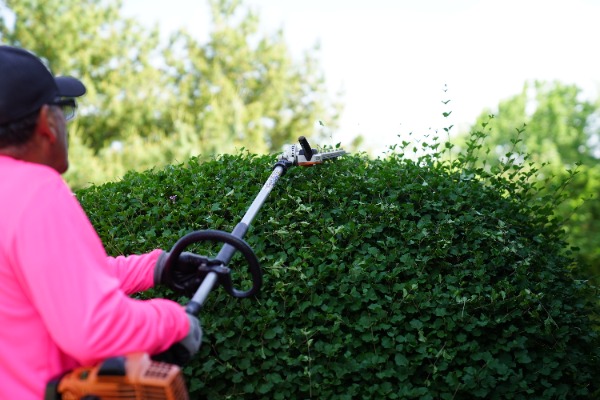
Shrubs are not meant to be shaped arbitrarily or cut back aggressively without purpose. Each shrub species has a natural growth habit that determines how it spreads, where it produces new growth, and how it responds to pruning. When trimming follows those natural patterns, shrubs respond with fuller growth, stronger branching, and improved resilience.
Correct pruning encourages new growth from the right locations on the plant, maintains airflow through the canopy, and prevents excessive stress. Over time, this results in shrubs that are easier to maintain, less prone to disease, and more visually balanced. Proper trimming also allows shrubs to allocate energy efficiently, rather than wasting resources trying to recover from unnecessary injury.
In contrast, improper trimming forces shrubs into survival mode, diverting energy away from healthy growth and into damage control.
Even well-intentioned trimming can cause harm if it’s done at the wrong time of year. Shrubs follow seasonal growth cycles, and pruning outside those windows can interfere with flowering, root development, and winter hardiness.
For flowering shrubs, incorrect timing may eliminate blooms for an entire year. For evergreen shrubs, late-season trimming can expose inner growth that isn’t equipped to handle sun, wind, or cold, leading to dieback that never fully recovers.
Poorly timed trimming can:
Shearing shrubs into tight, uniform shapes may look tidy at first, but it’s one of the most damaging long-term trimming practices. Shearing forces all new growth to the outer surface of the plant while starving the interior of light and air. Over time, sheared shrubs develop dense outer shells that block sunlight, leading to weak and brittle inner-branches.
Once the interior structure deteriorates, shrubs struggle to regenerate from within. Even if shearing stops, recovery can take years or may never occur depending on the species and severity of damage.
Improper trimming involves both the amount you cut away as well as how you cut. Jagged, torn, or poorly placed cuts leave shrubs vulnerable to pathogens and insects. These wounds take longer to seal, giving diseases and pests a direct entry point. Repeated poor cuts weaken the plant’s natural defense systems, leading to chronic decline rather than a one-time setback.
Common cutting mistakes include:
Shrubs are long-term landscape investments, often meant to thrive for decades. Improper trimming shortens that lifespan by forcing shrubs into cycles of stress and recovery they were never designed to endure.
Improperly trimmed shrubs may decline gradually, require more frequent replacement, and lose their ability to respond to corrective pruning. What begins as a cosmetic issue eventually becomes a structural and biological one, where replacement is the only practical solution.
Professional trimming focuses on plant health first, appearance second. Trained professionals understand how different shrub species grow, where to cut to encourage healthy branching, and how much material can safely be removed at one time.
Proper trimming preserves the shrub’s natural form, strengthens its structure, and ensures it can continue growing without stress. This proactive approach prevents the long-term damage caused by guesswork, overzealous cutting, or improper tools.
Q: Can shrubs recover from improper trimming?
A: Some shrubs can recover if the damage is minor, but severe or repeated improper trimming can cause permanent structural damage.
Q: How much of a shrub can be safely trimmed at once?
A: In most cases, no more than one-third of the shrub should be removed during a single trimming session.
Q: Is shearing ever appropriate for shrubs?
A: Shearing may be suitable for a limited number of formal hedge species, but it’s harmful for most ornamental shrubs.
Q: What happens if shrubs are trimmed too often?
A: Frequent trimming forces constant regrowth, weakening the plant and leading to thin, stressed growth.
Q: Can improper trimming affect flowering?
A: Yes. Trimming at the wrong time can remove flower buds and prevent blooming for an entire season or longer.
Q: Why do professionally trimmed shrubs last longer?
A: Professional trimming supports natural growth patterns, reduces stress, and prevents the cumulative damage that shortens shrub lifespan.

Touch up your lawn with Heartland Turf & Landscape